June 19, 2016

iphone 6plus: Hotel with a view. Collioure. South of France


From here you have a super view over to  the other side With Plage Boramar and Plage St. Vincent in Collioure. With a room at the hotel (to the right in the photo) you can enjoy a breakfast on the terrasse with a super view to the center of the idyllic village Collioure down here in the South of France - Close to the border of Spain.

June 17, 2016

iphone6plus Classic Collioure motif. South of France


A "must" for everyone visitng the small village Collioure is to have a version of the church with it feets out in the sea placed bewteen two small beaches in this popular tourist town.

"Among the village's more interesting sites is Notre-Dame des Anges, a waterfront church with a one-of-a-kind lighthouse-bell tower and overly ornate altar." (quotation Rick Stevens)

June 15, 2016

iphone6+ Start of the beach season in Collioure, South of France


In June there is still lot's of free space at the beach in Collioure. Water temp. at 17 deg Celcius is not so tempting and air temperature is only some 23C.

Beside of that the beach, one of 3 in this village, looks quite idyllic in the fair weather as it did this day.

EXIF
2 photos stitched (left part)
2016:06:12 13:54:56
Apple iPhone 6 Plus
Focal Length:
29mm (35mm eq.)
Aperture: f/2.2
Exposure: 1/3049s
Ev: 13.8
ISO equiv: 32

From the net:
Collioure is a seaside resort on the Languedoc coast, just north of the border with Spain and on the 'Vermeille Coast'. It was historically a small fishing village then after a time as an an important military centre, Collioure began to attract the artistic community including such renowned artists as Matisse and Derain in the early 20th century.
It is now a very popular destination with tourists and Collioure has a lively town centre with some interesting historical monuments and a popular local beach. With the castle and church creating an impressive backdrop, the beach and harbour are among the most scenic in Languedoc-Roussillon.

June 13, 2016

On top of Port-Vendres in the South of France


As we cross the small hill between Collioure and Port-Vendres we are welcomed with a fine bird view of the idyllic village Port-Vendres in the South of France. We can also see the deep water harbour in the back - an important destination for freighters coming up from Africa with exported products.

From the net:
Even before it became an important harbour of the Kingdom of Majorca during the 13th century, Port-Vendres had already been known since the 6th century BC by Greek navigators as « Portus veneris » (the port of Venus). There has always been an important shipping activity in this natural shelter.
From 1838 on, when France got involved in economical exchanges with North Africa, the port was enlarged and improved. It enabled Port-Vendres to become an important commercial port (“the shortest crossing and the most sheltered waters”). Goods and passengers traffic flourished and increased until 1962.


EXIF (main photo)
2016:06:08 11:13:39
Panasonic DMC-GX7
Focal Length:
40mm (35mm eq.)
Aperture: f/14
Exposure: 1/200s
Ev: 15.3
ISO equiv: 200

June 11, 2016

A walk along the foot of the Pyrenees, South of France


A good walk in the hilled landscape along the foot of the Pyrenees this pre summer day.
At the far away hill we can see the Madeloc tower - quite close to the border between France and Spain. 

Flower detail
EXIF (main photo)
2016:06:08 11:25:26
Panasonic DMC-GX7
Focal Length:
40mm (35mm eq.)
Aperture: f/14
Exposure: 1/160s
Ev: 14.9
ISO equiv: 200

June 10, 2016

Parallel parking a la France


Even in France there is not common that you have to open a concrete wall to be able to remove cars from the fields of paralell parking.

Whatever must have been in this drivers mind will for many of us be difficult to understand as we see this huge trailer catched with the front in the wall of the Lidl shop in Collioure - while the back part is stuck in the concrete wall facing the outside street. Regard the guy to the left in full swing with a concrete saw...


EXIF
2016:06:09 15:53:15
Apple iPhone 6 Plus
Focal Length:
29mm (35mm eq.)
Aperture: f/2.2
Exposure: 1/3300s
Ev: 14.0
ISO equiv: 32
Copyright: Jack R. Johanson

June 8, 2016

Finally there. Fort St. Elme. South of France


A fine day in the summer. Perfect to hike up from the old village Collioure to this little fortification above the city: Fort St. Elme. Rebuild after drawings from Vauban around 1650.
The first origins of the Fort goes back to around 8th century as it was a watchtower up here.

Port-Vendres in France in a 4 photos stitched panorama


This summer morning we did a walk from our apartment via Port-Vendres up to the summit with Fort St.Elme and back to Collioure. On the way we was rewarded with this fantastic view to the small village Port-Vendres by the coast of the Mediterranean down here in the South of France

As the day ends in Collioure, South of France


We are back in Our Apartment in the small village Collioure by the shores of the Mediterranian in South of France.  Only 2 minutes away we can walk to a nice spot to overlook the village and the sun as it sets to the west. A good place to be in this pre season of the summer.

June 2, 2016

iphone6+ Springflood, melted snow passing the Hydro Electric Power Plant, Askim, Norway


After many weeks the melted snow in the mountains is finally passing the huge Hydro electric Power Plant along the river Glomma in Askim, Norway - only some few kilometers more to go before the river ends up in the Oslofjord.

Difficult light for the iphone - a little overexposed water - still worth posting asking me...

May 31, 2016

Curmanns Old Nordic Villa in Lysekil, Sweden


Around 1880-1905 we had in Norway a popular architecture called the "Swiss dragon style villas". A blend of architecture style from Switzerland mixed with some details from the old Stave churches in Norway. I.E. dragonlike tree figures etc on the roof, corners of the building etc.

It seems also the Curmann family in Lysekil liked this style as they made their own houses within this concept. For sure  a most unique architecture in this small former fishing village.


May 30, 2016

Small marina in Lysekil, Sweden


In this pre season it is still many empty places out in this small marina just outside the center of the small maritime village Lysekil at the Swedish WestCoast.

May 29, 2016

Gamla Stan, Old Town, Lysekil, WestCoast of Sweden


GamlaStan - Old Town - in Lysekil. Typical with the narrow streets situated, when build, by the seashore. Today a little more withdrawn as land masses have been filled out in the old harbour.

Below house detail in the Old Town, Lysekil:


From the net:
Gamlestan in Lysekil is a unique town - obviously Lysekil, developed from the Old Town, but also for Bohuslän and probably for the whole of Sweden!

Gamlestan leads its history back to the first documented herring period in the 1500s. Lysekil "modern" history began with Johan Gabriel Mollén arriving to Lysekil in 1830. He was behind when Lysekil get market town rights in 1836.

May 28, 2016

Arriving in Lysekil at the WestCoast of Sweden


We are closing in to Lysekil and have this fine view from the ferry arriving from Skafto island.
The typical city prophile with the big church overlooking the harbour from it's placement up on a hill.

Typical street view in Lysekil:


From the net :Lysekil
Situated on the outhermost tip of the peninsula - with the Gullmar fjord to the east and the ocean to the west - there is always water in sight. Once a fishing village, Lysekil is now a town that gives emphasis to the industry and tourism.
Stroll the lanes of Gamlestan (Old Town), the original Lysekil of the 18th century. Visit the Maritime House and the provincial museum Vikarvet. Then continue along the water until you reach the Stångehuvud nature reserve.
Fiskebäckskil is only 10 minutes away by ferry-boat. There are daily boats leaving for the Gullholmen and Käringön islands and northbound along the coast to Smögen.

May 25, 2016

Panorama of Fiskebackskil at the Westcoast of Sweden


A fine day with a perfect vista over to the small village Fiskebackskil outside Lysekil at the WestCoast of Sweden. Find below another version of the idyllic coastal village.


From the net:
Fiskebäckskil is an old and genuine shipping community with narrow sidestreets and houses decorated with fancy carpentry work.
In the middle of the 19th century the inhabitants gave up fishing and became freight-skippers instead. They built themselves big and fine houses and were thus prepared when the seaside resort era started at the turn of the century. Fiskebäckskil became elegant and fashionable and still host many summer inhabitants from our capital.

Stroll the town's narrow lines for an hour or two, enjoy the picturesque car-free surroundings and a meal at "Captain Sture", a restaurant with oldfashioned fishing interiors nearby the church (built 1772).

May 23, 2016

Grundsund at the Westcoast of Sweden


The canal in Grundsund - a small Fishermans village at the WestCoast of Sweden.

Time to go home after a tasty lunch with shrimps and white wine in Grundsund Harbour:


Grundsund is a locality situated in Lysekil Municipality, Västra Götaland County, Sweden. It had 627 inhabitants in 2010. Wikipedia


May 20, 2016

The windmill and the house in Fiskebackskil. WestCoast of Sweden


From the low POV the old windmill and the stately house makes a good impression as we pass on our bikes under way for a typical WestCoast lunch in the fair weather this day in May.

The Madam enjoys here a delicious shrimp sandwich in a harbour restaurant:


From the net:
Fiskebäckskil is a locality in Lysekil Municipality, Västra Götaland County, Sweden, at the mouth of the Gullmarn fjord. It had 379 inhabitants in 2010. Once a fishing community, it transformed into a shipping community in the 19th century. Wikipedia

May 18, 2016

The long bike tour from Scotland to the Westcoast of Sweden


There is a long way biking from Scotland to the WestCoast of Sweden following Euro Velo Route 12 - The North Sea Cycle route. But why stop here when you may continue right up to the WestCoast of Norway and make yourself a trip of almost 6 000km length.
I am afraid that our small tours those days we spent at the WestCoast of Sweden vas no more than  1% of the total..... (this time).

Plan your tour right here: http://www.northsea-cycle.com/

From the net:
EuroVelo 12 (EV12), the North Sea Cycle Route, is a 5,942 km (3,692 mi) long-distance cycling route circuit around the coastlines of the countries that border the North Sea: these countries are (going clockwise from an arbitrary starting point of Harwich in Essex) England, Scotland, Norway, Sweden, Denmark, Germany, The Netherlands and Belgium.
The North Sea Cycle Route was officially opened in 2001, and is an international project between the countries participating, with 68 partners in 8 countries.
In 2003, the route was awarded a Guinness world record certificate confirming that the North Sea Cycle Route was the world's longest cycle route.

May 12, 2016

Grundsund an idyllic fishermans village at the WestCoast of Sweden

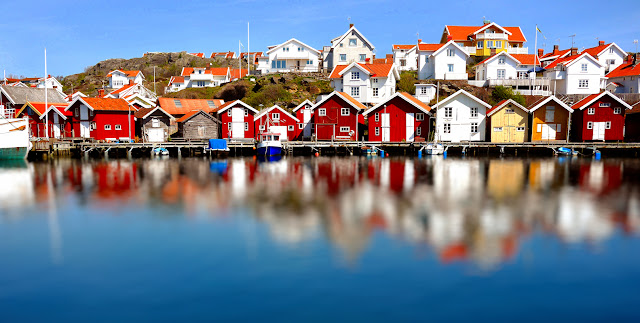
Grundsund in May (in a partly tiltshift effect)
A fanatastic place to visit. We arrived on our bicycles after a super tour along the Coat Path from Fiskebackil. The red and white houses balance perfect to the blue sky and sea on this fine day.

We hade this fine view from our lunch place in the harbour where we enjoyed a fresh made shrimp sandwich and a cold beer.


From the net: Grundsund
Grundsund is a typical Bohuslän fishing village, and yet not. For similarities to spite; boathouses, the closely spaced houses, etc., every coastal community its unique character and history.

Grundsunds history is primarily history of fishing. The transformation from fishing village to the skipper society and seaside resort, like many other coastal communities such as Fiskebäckskil went through in the 1800s, never worked in Grundsund.

Although elements of both freight speed and some bathers letting kept fishing its leading position. Therefore, we find this not the great captain's houses or the graceful badgäst- architecture with its glass verandas and lövsågssnickerier. What characterizes the buildings are instead "law of equality." The houses are usually small and have a frugal decorating fishery democratic organization can thus be traced in the buildings.

On both sides of the narrow strait that connects Gåsöfjorden in the north with Värbo- fjord in the south, and that is something of Grundsunds spine, society has gradually emerged. Here we see the row of boathouses and warehouses that form front against the water and behind them the bright closely spaced houses climbing up the slopes. During the first World War was dug a canal in the area around where the bridge is now located. Then you could go by cargo ships through the harbor from north to south.

May 10, 2016

Touch of summer in Fiskebackskil at the WestCoast of Sweden


We are just back from some fine days with a touch of Summer along the fine WestCoast of Sweden.
This photo is shot at a small fishing village by the name of Fiskebackskil - and as you can see we look over the narrow fjord to another larger village Lysekil with the visible church there placed on a hill out by the sea.