May 31, 2016
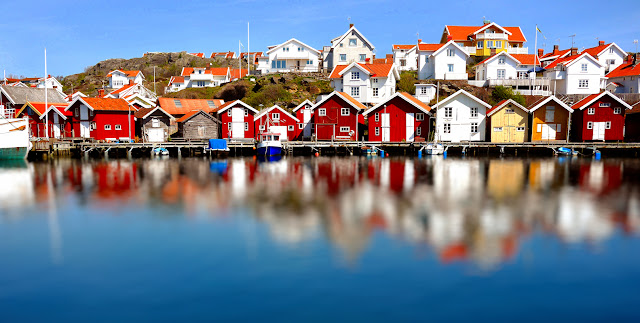
Curmanns Old Nordic Villa in Lysekil, Sweden
Around 1880-1905 we had in Norway a popular architecture called the "Swiss dragon style villas". A blend of architecture style from Switzerland mixed with some details from the old Stave churches in Norway. I.E. dragonlike tree figures etc on the roof, corners of the building etc.
It seems also the Curmann family in Lysekil liked this style as they made their own houses within this concept. For sure a most unique architecture in this small former fishing village.
May 30, 2016
Small marina in Lysekil, Sweden
In this pre season it is still many empty places out in this small marina just outside the center of the small maritime village Lysekil at the Swedish WestCoast.
May 29, 2016
Gamla Stan, Old Town, Lysekil, WestCoast of Sweden
GamlaStan - Old Town - in Lysekil. Typical with the narrow streets situated, when build, by the seashore. Today a little more withdrawn as land masses have been filled out in the old harbour.
Below house detail in the Old Town, Lysekil:
From the net:
Gamlestan in Lysekil is a unique town - obviously Lysekil, developed from the Old Town, but also for Bohuslän and probably for the whole of Sweden!
Gamlestan leads its history back to the first documented herring period in the 1500s. Lysekil "modern" history began with Johan Gabriel Mollén arriving to Lysekil in 1830. He was behind when Lysekil get market town rights in 1836.
May 28, 2016
Arriving in Lysekil at the WestCoast of Sweden
We are closing in to Lysekil and have this fine view from the ferry arriving from Skafto island.
The typical city prophile with the big church overlooking the harbour from it's placement up on a hill.
Typical street view in Lysekil:
From the net :Lysekil
Situated on the outhermost tip of the peninsula - with the Gullmar fjord to the east and the ocean to the west - there is always water in sight. Once a fishing village, Lysekil is now a town that gives emphasis to the industry and tourism.
Stroll the lanes of Gamlestan (Old Town), the original Lysekil of the 18th century. Visit the Maritime House and the provincial museum Vikarvet. Then continue along the water until you reach the Stångehuvud nature reserve.
Fiskebäckskil is only 10 minutes away by ferry-boat. There are daily boats leaving for the Gullholmen and Käringön islands and northbound along the coast to Smögen.
May 25, 2016
Panorama of Fiskebackskil at the Westcoast of Sweden
From the net:
Fiskebäckskil is an old and genuine shipping community with narrow sidestreets and houses decorated with fancy carpentry work.
In the middle of the 19th century the inhabitants gave up fishing and became freight-skippers instead. They built themselves big and fine houses and were thus prepared when the seaside resort era started at the turn of the century. Fiskebäckskil became elegant and fashionable and still host many summer inhabitants from our capital.
Stroll the town's narrow lines for an hour or two, enjoy the picturesque car-free surroundings and a meal at "Captain Sture", a restaurant with oldfashioned fishing interiors nearby the church (built 1772).
May 23, 2016
Grundsund at the Westcoast of Sweden
The canal in Grundsund - a small Fishermans village at the WestCoast of Sweden.
Time to go home after a tasty lunch with shrimps and white wine in Grundsund Harbour:
Grundsund is a locality situated in Lysekil Municipality, Västra Götaland County, Sweden. It had 627 inhabitants in 2010. Wikipedia
May 20, 2016
The windmill and the house in Fiskebackskil. WestCoast of Sweden
From the low POV the old windmill and the stately house makes a good impression as we pass on our bikes under way for a typical WestCoast lunch in the fair weather this day in May.
The Madam enjoys here a delicious shrimp sandwich in a harbour restaurant:
Fiskebäckskil is a locality in Lysekil Municipality, Västra Götaland County, Sweden, at the mouth of the Gullmarn fjord. It had 379 inhabitants in 2010. Once a fishing community, it transformed into a shipping community in the 19th century. Wikipedia
May 18, 2016
The long bike tour from Scotland to the Westcoast of Sweden
There is a long way biking from Scotland to the WestCoast of Sweden following Euro Velo Route 12 - The North Sea Cycle route. But why stop here when you may continue right up to the WestCoast of Norway and make yourself a trip of almost 6 000km length.
I am afraid that our small tours those days we spent at the WestCoast of Sweden vas no more than 1% of the total..... (this time).
Plan your tour right here: http://www.northsea-cycle.com/
From the net:
EuroVelo 12 (EV12), the North Sea Cycle Route, is a 5,942 km (3,692 mi) long-distance cycling route circuit around the coastlines of the countries that border the North Sea: these countries are (going clockwise from an arbitrary starting point of Harwich in Essex) England, Scotland, Norway, Sweden, Denmark, Germany, The Netherlands and Belgium.
The North Sea Cycle Route was officially opened in 2001, and is an international project between the countries participating, with 68 partners in 8 countries.
In 2003, the route was awarded a Guinness world record certificate confirming that the North Sea Cycle Route was the world's longest cycle route.
May 12, 2016
Grundsund an idyllic fishermans village at the WestCoast of Sweden
![]() |
| Grundsund in May (in a partly tiltshift effect) |
We hade this fine view from our lunch place in the harbour where we enjoyed a fresh made shrimp sandwich and a cold beer.
From the net: Grundsund
Grundsund is a typical Bohuslän fishing village, and yet not. For similarities to spite; boathouses, the closely spaced houses, etc., every coastal community its unique character and history.
Grundsunds history is primarily history of fishing. The transformation from fishing village to the skipper society and seaside resort, like many other coastal communities such as Fiskebäckskil went through in the 1800s, never worked in Grundsund.
Although elements of both freight speed and some bathers letting kept fishing its leading position. Therefore, we find this not the great captain's houses or the graceful badgäst- architecture with its glass verandas and lövsågssnickerier. What characterizes the buildings are instead "law of equality." The houses are usually small and have a frugal decorating fishery democratic organization can thus be traced in the buildings.
On both sides of the narrow strait that connects Gåsöfjorden in the north with Värbo- fjord in the south, and that is something of Grundsunds spine, society has gradually emerged. Here we see the row of boathouses and warehouses that form front against the water and behind them the bright closely spaced houses climbing up the slopes. During the first World War was dug a canal in the area around where the bridge is now located. Then you could go by cargo ships through the harbor from north to south.
May 10, 2016
Touch of summer in Fiskebackskil at the WestCoast of Sweden
We are just back from some fine days with a touch of Summer along the fine WestCoast of Sweden.
This photo is shot at a small fishing village by the name of Fiskebackskil - and as you can see we look over the narrow fjord to another larger village Lysekil with the visible church there placed on a hill out by the sea.
May 6, 2016
Sailing along Lysekil at the West Coast of Sweden
Just outside the old village Lysekil this sailer is out on a fine day in the early summer. Typical landscape along this part of the Swedish West Coast with the island Skaftø in the back.
As a contrast to this Sailing - in nearly excact the same place back in 1890:
flickr link: https://www.flickr.com/photos/swedish_heritage_board/3332817568/
Photograph by: Carl Curman
Date: c. 1890
Format: Print
April 30, 2016
iphone6+ Flashback to Port-Vendres, France in January
A January with such a flowering scene is a pleasure for the eye.
Here right by the border to Spain. Along the coast called Cote Vermeille here in France which will become Costa Brava as soon as we pass the border to Spain. The rugged coast starts here and continue right down to Barcelona.
April 29, 2016
iphone6+ Flashback to Collioure, South of France
Lovely Collioure a day in January. South of France - always attractive even in the low Seasons for those of us who are used to snow and a Cold climate at this time of the year....
April 27, 2016
iphone 6+ Flashback to Collioure, South of France in the spring
Collioure in South of France in January. While the trees are pointing their fingers up to the blue sky - waiting to have the branches covered with green leaves.
April 25, 2016
iphone 6+ April in the Oslofjord, Norway
March 13, 2016
In the end of the world: Svalbard, Norway
I am standing a bit North of Thomas and his 2 children making this photo.
For all I know I can be the person closest to the North Pole in the world (but of course there is probably some people around the Pole point - maybe some scientists).
We are looking over the Isfjorden to Longyearbyen that can be seen to the left in the photo. To the right you can see the runway at Longyearbyen Airport.
We are on the top of Mont Hiorthfjellet where we arrived with a brand new SnowCat in company of some 20 other visitors. The weather was not the best with whipping wind and a small snow blizzard.
![]() |
| Dressed for an Arctic climate |
A SnowCat with Explorers at the top of Mount Hjorthfjellet - Svalbard, Norway
We have taken the brand new SnowCat up the mountainside of Hjorthfjellet right opposite of the "capitol" Longyearbyen and the big fjord Isfjorden.
The snowCat was just delivered to Spitsbergen Travel our tour operator and was filled with "explorers" this day. Beside of some Norwegians you can to the left see a well "packed" lady from Lyon, France and to the right a small group from sunny Australia doing some souvenir photos of the event.
Unfortunately not the best weather this March afternoon - but maybe a snow blizzard and some wind adds to the spectacle of being up here.
Below from another stop with the SnowCat at the permafrost of the moors in the end of the Adventsfjorden - on our way back to Longyearbyen.
The Arctic Reindeer at Svalbard, Norway
During our days at Spitsbergen, Svalbard we did not meet the Polar Beer - but did see some Reindeers scattered around.
The reindeers up here have shorter legs and necks and looks more like a "ball" than the ones we find in the mainland of Norway. Surely due to a much tougher climate.
Svalbard Reindeer (wiki):
The Svalbard reindeer (Rangifer tarandus platyrhynchus) is a reindeer subspecies found on the Svalbard archipelago of Norway. They are the smallest subspecies of reindeer. Males average 65-90 kg in weight, females 53-70 kg,while for reindeer generally body mass is 159–182 kg for males and 80–120 kg for females.
The subspecies is endemic to the Svalbard islands, where it has lived for at least 5,000 years, and become well adapted to the harsh climate, being found on nearly all non-glaciated areas of the archipelago. It is the most northern living herbivore mammal in the world.
They remain short-legged and have a relatively small, rounded, head. Their fur is also lighter in colour and thicker during winter.The thickness of the coat contributes to the short-legged appearance and makes even starved animals appear fat in the winter. The males develop large antlers during the period from April to July and shed the velvet during August-September. Males lose their antlers in early winter. Females develop antlers starting in June and they are usually retained for a whole year.
March 12, 2016
How to park a dogsled at Svalbard, Norway
After a 3hrs tour with 6 dogs from Green Dog in Longyearbyen at Spitsbergen Thomas and Milla is returning with their dogsled.
The eager dogs are still pulling at full while Thomas is having a foot on the brakes to slow down and stop the dogs. You can see in his right hand that he is holding the anchor which must be placed in the snow to keep the dogs in place after they have stopped. Simple as that.
The Green Dog do two such trips twice a day in the season mainly for people with no experience from dogsleds - and usually everyone come back full of enthusiasm for the experience.
Some instructions before the tour is all training needed.
And of course both Thomas and Milla is dresssed in Thermodresses from Green Dog to keep them warm in the cold Arctic day.
Finally the dogs have to be returned to their small "houses" at the kennel - as Milla is doing right here:
The dog kennel. Longyearbyen, Svalbard, Norway
In the afternoon, on our way home, we pass another dog kennel on route to Longyearbyen, the small village and "capitol" up here in the Arctic landscape at Svalbard.
There is some 2.000 inhabitants living here and of course som 1.000 dogs: Alaskan huskies and the larger Greenland dogs. The dogs in full swing pulling their sleds for all the tourists coming up to this Arctic landscape of snow and darkness.
Subscribe to:
Posts (Atom)


