March 28, 2014
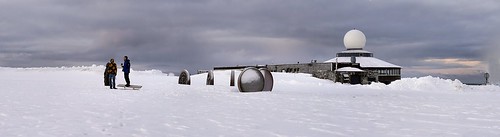
Norway - The North Cape Center
March 27, 2014
Tour to Norway Arctic - Sjoegata / Sjøgata in Tromso / Tromsø
Tour to Norway Arctic. Day 04 Tromsø - Sjøgata
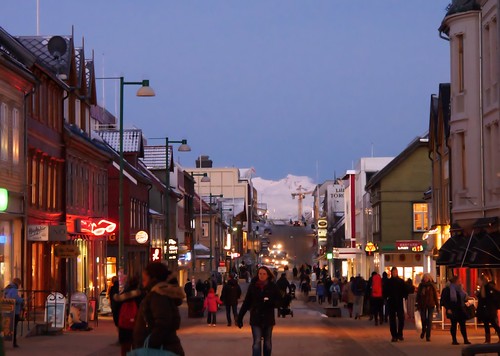
Sjøgata can be considered Tromsø's oldest street. It was built between Skansen and the church then lay a few hundred meters south of Prostneset. Along with Strand Street and Skippergata followed the shoreline, and is therefore not entitled as planned streets that Tromsø's main street today. Early in its history it was the main commercial street.
In this photo version I present a tilt-shift variant.
From wiki:
Tromsø is a city and municipality in Troms county, Norway.
It is the largest city and the largest urban area in Northern Norway, and the second largest city and urban area north of the Arctic Circle in Sápmi (following Murmansk).
Most of Tromsø, including the city centre, is located on the small island of Tromsøya in the county of Troms, 350 kilometres (217 mi) north of the Arctic Circle. Substantial parts of the urban area are also situated on the mainland to the east, and on parts of Kvaløya — a large island to the west.
Tromsøya is connected to the mainland by the Tromsø Bridge and the Tromsøysund Tunnel, and to the island of Kvaløya by the Sandnessund Bridge. The city is warmer than most other places located on the same latitude, due to the warming effect of the Gulf Stream.
The city centre of Tromsø contains the highest number of old wooden houses in Northern Norway, the oldest house dating from 1789.
The Arctic Cathedral, a modern church from 1965, is probably the most famous landmark in Tromsø.March 24, 2014
Norway - the Arctic Cathedral
March 21, 2014
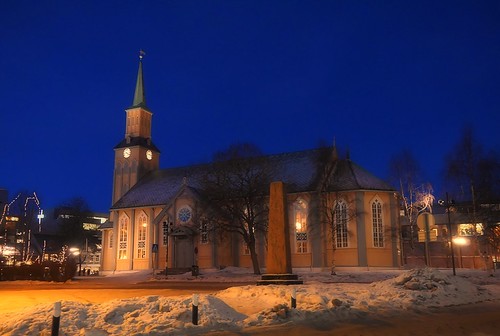
Norway Arctic - Tromsø / Tromso Cathedral
March 20, 2014
Norway Arctic - mainstreet Tromsø / Tromso
March 19, 2014
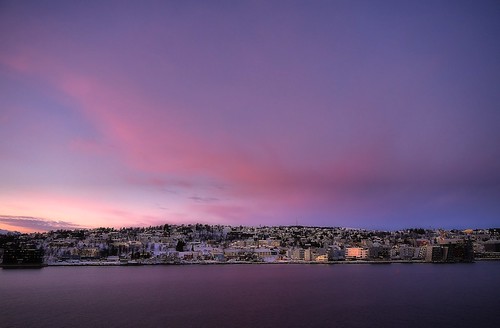
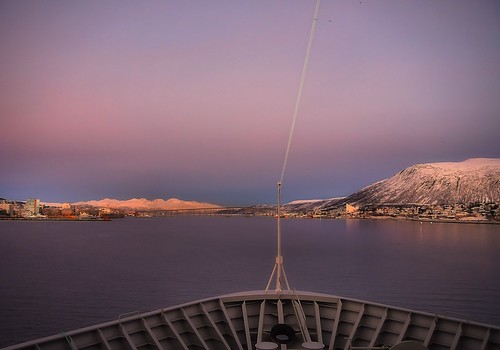
Norway, Tromso, arrival in a magic winter afternoon light
Tour to Norway North Cape. Day 04 Tromsø
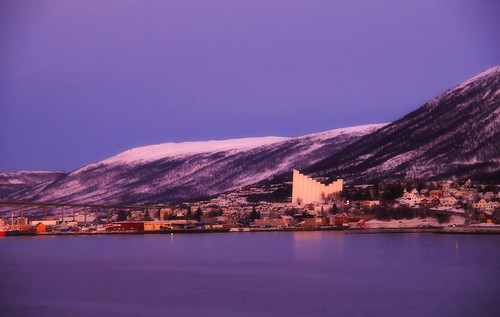
On this tour I visited Tromsø twice. First for a long stop on the tour North with the MS Midnatsol where we arrived in the typical light of an early winter afternoon as displayed in this photo taken at 14.15 when sailing in the Tromsøsundet.
From wiki:
Tromsø is a city and municipality in Troms county, Norway.
It is the largest city and the largest urban area in Northern Norway, and the second largest city and urban area north of the Arctic Circle in Sápmi (following Murmansk).
Most of Tromsø, including the city centre, is located on the small island of Tromsøya in the county of Troms, 350 kilometres (217 mi) north of the Arctic Circle. Substantial parts of the urban area are also situated on the mainland to the east, and on parts of Kvaløya — a large island to the west.
Tromsøya is connected to the mainland by the Tromsø Bridge and the Tromsøysund Tunnel, and to the island of Kvaløya by the Sandnessund Bridge. The city is warmer than most other places located on the same latitude, due to the warming effect of the Gulf Stream.
The city centre of Tromsø contains the highest number of old wooden houses in Northern Norway, the oldest house dating from 1789.
The Arctic Cathedral, a modern church from 1965, is probably the most famous landmark in Tromsø.March 18, 2014
Norway, Senja - Magical Arctic Light
Norway Arctic. Day 04 - The Magical Arctic light
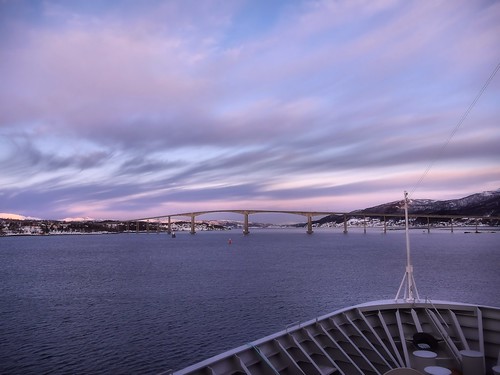
That afternoon at 11.45 AM we departed the village Finnsnes on our way north. Right ahead of the ship we see the grand bridge from the mainland and over to the island Senja. And then: What a magic light - already at this time of the day in late January the sunset is making it's magic in the lightly clouded sky (of course some minor adjustment of contrast and color adjustments expose the light even better in the presented result (but no HDR or exaggerated adjustments)).
Our screens looks often different - Still study the strange light apparently in the clouds in the left part (under the big cloud). Regard the strange colors - not red, not blue but maybe in the direction of green. Is it possible that we have a very early glimpse of the coming Northern Light? (that later in the evening was quite strong this day). I don't know.
Anyway this journey was for me a total surprise with days that I within a few hrs had those stunning sunrises and sunsets.
From the net:
Gisund Bridge is a cantilever road bridge on Norwegian County Road 86 in Troms county, Norway.
The bridge crosses the Gisundet strait from the town of Finnsnes on the mainland to the village of Silsand on the island of Senja.
The 1,147-metre (3,763 ft) long bridge has 25 spans, the main span being 143 metres (469 ft) long. The maximum clearance to the sea below the bridge is 41 metres (135 ft). Gisund Bridge was opened on 23 June 1972.
Senja - Norways second largest island
Senja (Northern Sami: Sážžá) is the second largest island in Norway (not counting Svalbard).
Norwegian musician Moddi comes from the island and his music has been said to have been influenced by the beauty of the island.
Senja is located along the Troms county coastline with Finnsnes as the closest town. The municipalities located on Senja are Lenvik (part of which is on the mainland), Berg, Torsken, and Tranøy. Senja had 7782 inhabitants as of 1 January 2008.
The north and western coasts of Senja are facing the open sea. Here, steep and rugged mountains rise straight from the sea, with some fishing villages (like Gryllefjord, Husøy) wherever there is some lowland. The eastern and southern parts of the island are milder, with rounder mountains, forests, rivers and agriculture land.March 16, 2014
Good morning from Norway Arctic
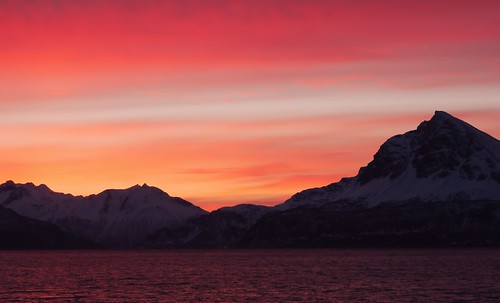
Tour to Norway, North Cape. Day 04. Arctic morning
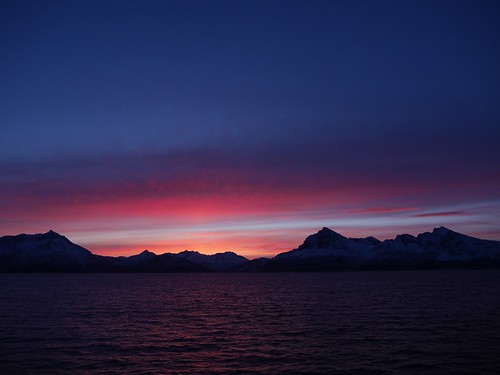
This photo is taken 9.26AM at sunrise, Jan, 22. 2014. Focal lenght 45mm (90mm). According to my sailing plan with the coastal express we was at that time app. at 68 degrees North (a bit north of Harstad) which we departed 8.00AM).
There is another photo taken in the same minute with focal length 14mm (28mm) that presents quite a different color set for this sunrise. Have a look at:
www.flickr.com/photos/jrjohanson/12716260883
What to say for two photos taken in the same minute, with so different light, of the same landscape a winter morning in Januaray sailing with Hurtigruten, the coastal steamer, north along our very long coastline right up to the North Cape.
March 15, 2014
Norway Arctic - departure in Arctic Blue
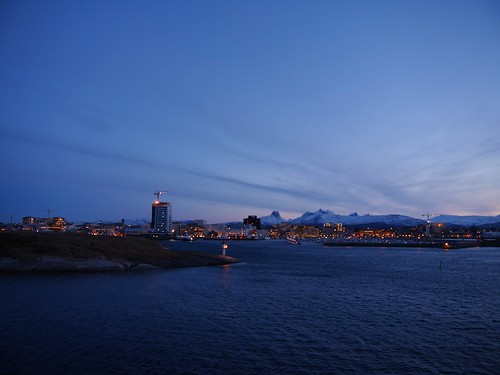
Norway Arctic. Day 04 -Blue departure from Bodø
The tour continues and after a stay in the main city of the Nordland county: Bodø we departure on our way to cross the Vestfjorden going to Lofoten.
As you see in a very fine blue hour of the afternoon (3.17PM).
I had done my best to travel this tour under calm sailing conditions (not ordering any tickets before I was reasonably sure of the weather (less than 10 days in front of my tour)).
In this video from the last days you can get an impression of how it can be in the winter time when Hurtigruten departs Bodø in typical winter weather and not the max weather I had:
www.nrk.no/nordland/uvaeret-rammer-fergene-1.11603555
February 28, 2014
Norway Arctic - passing 1 of our 50000 Islands along the coast
February 27, 2014
Norway Arctic: Sailing with MS Midnatsol
February 26, 2014
Norway Arctic - the places we live
February 25, 2014
Norway - layered sunset in January
Tour to Norway, North Cape. Day 02 - Layered Fjord Sunset
I left the central town of mid Norway, Trondheim, at noon with the coastal express MS Midnatsol.
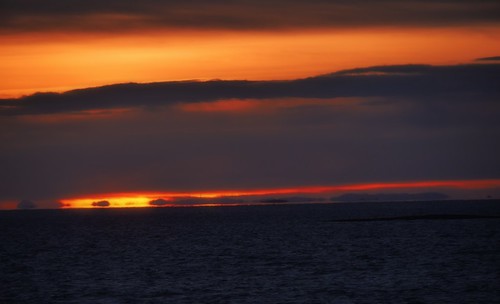
I am sailing out the Trondheimsfjorden on my way North. At 3.40 PM the sun is setting partly hidden by some low clouds drifting over the sea out there.
From the net:
The Trondheimsfjord an inlet of the Norwegian Sea, is Norway's third longest fjord at 130 kilometres (81 mi) long. It is located in the west central part of the country, and it stretches from Ørland in west to Steinkjer in north, passing the city of Trondheim on its way.
Its maximum depth is 617 metres (2,024 ft), just inside of Agdenes.
The largest islands in the fjord are Ytterøy and Tautra; the small Munkholmen is located near the harbor of Trondheim; and there are several islands at the entrance of the fjord.
February 24, 2014
Norway Arctic: Where is the European highway E6?
February 23, 2014
Norway Arctic - A Lumix GX7 photo
Tour to Norway, North Cape. Day 04 North of Harstad
As you may have noted I did this tour using my new, mirrorless system camera: Panasonic Lumix GX7.
My 4:3 lens is an Olympus M. Zuiko Digital ED 14-150mm (35mm equal= 28-300mm), F4.05.6. (Why I made a choice for the Olympus lens was purely a price question as the equal Lumix lens was considerably more expensive.
Combined with the fact that the main difference, according to some tests, was that the Panasonic had a lens stabilizer which Olympus did not have. On the other hand the new camera have a camera stabilizer build in the house so no big deal.)
After being a Nikon fan through many DSLR years (even before that with the traditional SLR cameras), and then a short period with Canons top compact camera the Canon G1X, I was very impressed reading some tests on my present Panasonic Lumix GX7 mirrorless system camera (comes even with a super electronic viewfinder) - and ended up with the gear as mentioned above.
As an example of the result you can have right out of the RAW file I present this photo taken in the incredible light in north of the Arctic Circle where the sun in January, in the middle of the dark winter, was rising (under my tour) around 9.30AM and was setting around 2.30PM. Some variations depending on how far north I was at the different days.
Today I present you with a jpg version that is totally without any PP Process from the RAW file - that is except for reformatting from 4592x3448 pixels to 1065x800 pixels (click the photo).
(My usually PP process for the photos used in this series is: Cropping, digital noise removal (ev. Classical soft focus), sharpening and adjustment of levels (or curves) (light and contrast). (But as mentioned in this photo only resizing.)
The photo is taken 9.26AM at sunrise, Jan, 22. 2014. According to my sailing plan with the coastal express we was at that time app. at 68 degrees North (a bit north of Harstad) which we departed 8.00AM).
(Are you in any need to see the full size photo - contact me.).February 22, 2014
Winter holidays in Norway
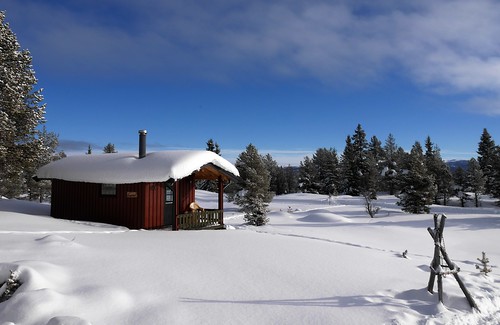
Our small "guest house" was again in use at our mountain place this week as we had some days off for our traditional "winter holiday".
February 14, 2014
North Cape, Norway - Children of the World
On Tour to North Cape - day 06 - Finally there III
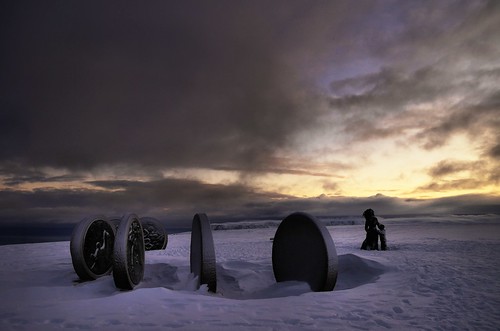
To be found at the North Cape by the tourist Center: The "Children of the world" sculpture created by Seven children from Thailand to Tanzania.
Here photographed at a visit a grey day in January.
It was strange being almost alone around this great sculpture partly covered in snow in a very low light environment - still with a fading sun in the clouded sky.
And I think this photo version of the sculpture on this day for me was a small highlight as I walked around in solitude at North Cape - outside and inside the big North Cape center.
(BTW the blue in the snow is due to the Arctic low light winter season not any idea, wish or PP from my side :-))
From the net:
The “Children of the World” sculpture was started in 1988 when author Simon Flem Devold randomly selected seven children from seven countries – Tanzania, Brazil, USA, Japan, Thailand, Italy and Russia — to visit the North Cape to dream of “Peace on Earth”.
During their seven day visit, each of the 8-to12-year-old children made a clay relief symbolizing friendship, hope, joy and working together. In 1989 the reliefs were enlarged, case in bronze and erected in a semi-circle outside the North Cape Hall. A “Mother and Child “monument by sculptor Eva Rybakken points toward the seven disks.
February 13, 2014
Tour to North Cape, Norway. Day 06 - finally there II
February 12, 2014
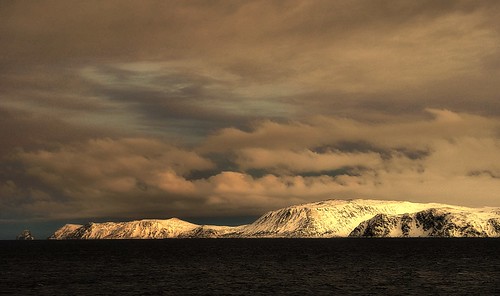
Norway: Arctic landscape - day 05
On the Coastal steamer MS MIdnatsol on tour to my final destination Honningsvaag and North Cape
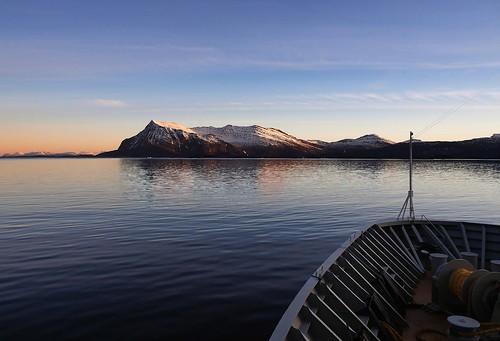
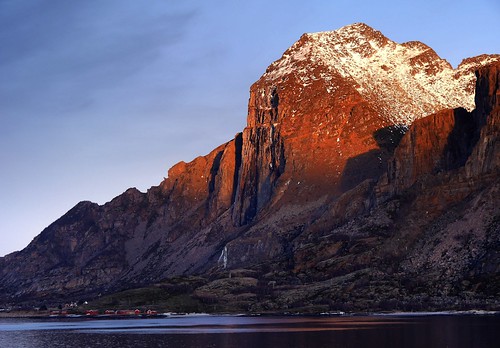
In the short time between sunrise and sunset the low light present the landscape in a fine way with good details on the clouded day.
Some Norway info from the net:
Norway has a very elongated shape, one of the longest and most rugged coastlines in the world, and some 50,000 islands off the extremely indented coastline. The mainland covers 13° latitude, from 58°N to more than 71°N, (Svalbard north to 81°N), and covers the longitude from 5°E in Solund to 31°E in Vardø (Jan Mayen to 9°W, Kvitøya to 33°E).
Norway is one of the world's most northerly countries, and one of Europe's most mountainous countries with large areas dominated by the Scandinavian Mountains; average elevation is 460 m and 32% of the mainland is located above the tree line.
Virtually the entire country was covered with a thick ice sheet during the last ice age, as well as in many earlier ice ages. The movement of the ice carved out deep valleys, and when the ice melted, the sea filled many of these valleys, creating Norway's famous fjords.February 11, 2014
Tour to Norway North Cape. Day 04 - arrival in Tromsoe
Tour to Norway, North Cape. Day 04 Arriving with the Coastal Express MS Midnatsol to Tromsø
The largest town in Norway Arctic is coming up in front of the ship as we, in the artic afternoon light, sails towards the harbour which will be at the left side of the bridge in the far distant. To the right you can see the Arctic Cathedral with the typical white walls.
From the net_
Tromsø city is the ninth-largest urban area in Norway by population, and the seventh largest city in Norway by population. It is the largest city and the largest urban area in Northern Norway, and the second largest city and urban area north of the Arctic Circle (following Murmansk).
Most of Tromsø, including the city centre, is located on the small island of Tromsøya in the county of Troms, 350 kilometres (217 mi) north of the Arctic Circle. Substantial parts of the urban area are also situated on the mainland to the east, and on parts of Kvaløya—a large island to the west. Tromsøya is connected to the mainland by the Tromsø Bridge and the Tromsøysund Tunnel
The city is warmer than most other places located on the same latitude, due to the warming effect of the Gulf Stream.
The city centre of Tromsø contains the highest number of old wooden houses in Northern Norway, the oldest house dating from 1789. The Arctic Cathedral, a modern church from 1965, is probably the most famous landmark in Tromsø.